Got Heat Adaption?
Heat Is Not the Enemy. Ignorance Is.
A field-tested protocol for training through summer without wrecking yourself.
This article is primarily for those who will be participating in outdoor sports or races this summer. If you do not do much outside, enjoy the AC and keep getting to the gym.
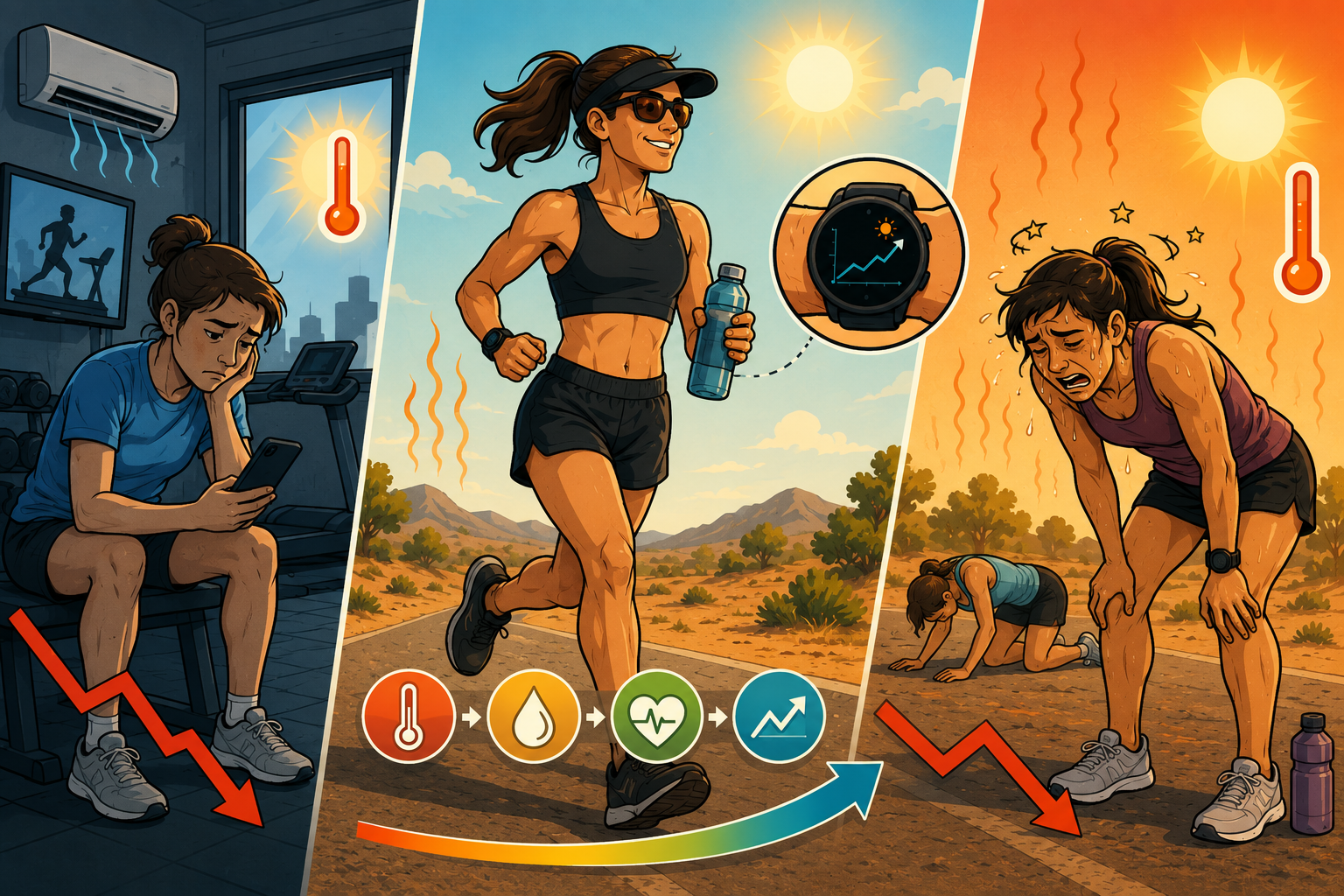
Every summer the same two mistakes repeat themselves across gyms, tracks, and race courses. One group disappears indoors the moment the thermometer clears eighty degrees, trading months of outdoor conditioning for air conditioning and quietly losing the fitness they spent all spring building. The other group grinds through July exactly the way they trained in April, refusing to adjust pace, hydration, or intensity, and ends up cramping, dizzy, or worse. Both groups are making the same underlying error. They are treating heat as a condition to survive instead of a stimulus to adapt to.
Heat tolerance is trainable. It is not a personality trait, and it is not something you either have or don't. It is tracked on Garmin watches. The body's response to repeated heat exposure follows the same adaptive logic as aerobic capacity or strength: apply a controlled stress, recover, and the system upgrades itself to handle that stress with less strain next time. Skip the exposure and you skip the adaptation, no matter how fit you are in cooler conditions.
With repeated heat exposure, sweating starts earlier and at a higher rate, which cools the skin faster. Blood plasma volume expands, allowing the body to send more blood to the skin for cooling without lowering blood pressure elsewhere. The core temperature at which the body kicks into full defensive mode drops, meaning you can work harder before your internal alarm system goes off. Most of this develops within one to two weeks of consistent exposure, which is both the good news and the bad news. Good news because it is fast. Bad news because it does not happen by accident on the two hot days a month you happen to train outside. I have never seen adaptation happen faster than 2 weeks. But the research says it can happen.
This is where fitness misleads people. A well-conditioned athlete adapts to heat faster and holds onto that adaptation longer than someone who is aerobically untrained, but general fitness does not substitute for heat exposure itself. You cannot out-run your way to heat tolerance on a treadmill in an air-conditioned gym. The adaptation is specific to the stress, and the stress is heat.
The Protocol
Start the acclimatization block fourteen days before you need to perform in the heat, not the week of.
Train outdoors, in the heat, most days during that window. Consistency matters more than intensity here.
Aerobic work drives the adaptation better than lifting. Easy runs, rides, walks. Save hard lifting for indoors during the acclimatization phase.
Aim for sixty to ninety minutes of heat exposure per session. Split it into two shorter sessions if that's more realistic than one long one.
Start easy. First few days should feel almost too light. Your job is to raise core temperature and sweat, not to hit splits.
Add intensity gradually across the block. By the second week you should be able to hold something closer to normal effort.
Weigh yourself before and after sessions. Replace roughly sixteen ounces of fluid for every pound lost.
Add sodium. Plain water alone during long, sweaty sessions can dilute the sodium you already have left. Use an electrolyte drink or salted food, not just water. Cowbell was made for this!
Train during the actual conditions you'll compete or work in when possible. If race day is midday heat, don't do all your prep at 6 a.m.
Know the difference between heat exhaustion and heat stroke before you need to know it. Heavy sweating, nausea, headache, weakness: stop, cool down, hydrate. Confusion, stumbling, hot dry skin, or collapse: that's an emergency, not a gut-it-out moment.
If you have to skip more than four or five days mid-block, expect to lose some adaptation. Two to four easy heat sessions will bring most of it back.
Once acclimatized, one heat exposure every four to five days is usually enough to maintain it through the season.
None of this is complicated, and none of it requires a heat chamber or a lab. It requires doing the unglamorous thing: showing up in the heat on purpose, on a schedule, before you need the fitness rather than after you've already suffered for it. That is the same principle behind every durable training method I've ever coached. The people who thrive in hard conditions are not the ones with the most talent. They are the ones who exposed themselves to the specific demand early enough for their body to adapt to it.
See you in the gym. —JG