Why Your Cardio Isn't Making You Fit
You work hard. The problem is what "hard" is actually doing.
You finish the workout breathing heavy. You're sweating through your shirt. Your legs are tired, and your heart rate was elevated for the better part of an hour. By any reasonable measure, that felt like work, and in a sense, it was. The question worth asking, and the one most people never ask, is whether the cardiovascular system got the message you think you sent it.
Most of the time, it didn't.
There's a gap in fitness that rarely gets talked about, not because it's complicated, but because it's uncomfortable. It sits between the effort you perceive and the stimulus your body actually receives. These two things feel like the same thing. They aren't. And confusing them is why a significant number of people have been doing cardio consistently for years and are still, by any meaningful physiological measure, not particularly fit.
The cardiovascular system is not impressed by discomfort. It responds to specific demands, principally the need to move oxygen at high rates for sustained periods, which forces adaptations that actually constitute fitness: increased stroke volume, greater mitochondrial density, improved VO2 max, and a heart that pumps more blood per beat at rest and under load. These are not vague improvements. They're structural and measurable, and they require a specific intensity of effort to occur. Below that threshold, you're burning calories. You may be managing stress. You might even be extending your life in modest ways. But you are not building cardiovascular fitness in any meaningful sense, and you are almost certainly not building it at the rate you believe.
Here is where the research gets direct. Studies consistently show that low-intensity endurance work improves performance at low intensities, and essentially nothing else. The aerobic capacity gains, the improvements in VO2 max, the cardiac structural changes that define a genuinely fit cardiovascular system, those adaptations belong to higher intensities. One study found that increasing training intensity produced greater cardiovascular adaptations than maintaining a moderate intensity, even when total energy expenditure was identical. You could work the same number of hours at a harder effort and get substantially more out of it. More to the point, you can keep working the same number of hours at your current effort and keep getting more or less what you've been getting.
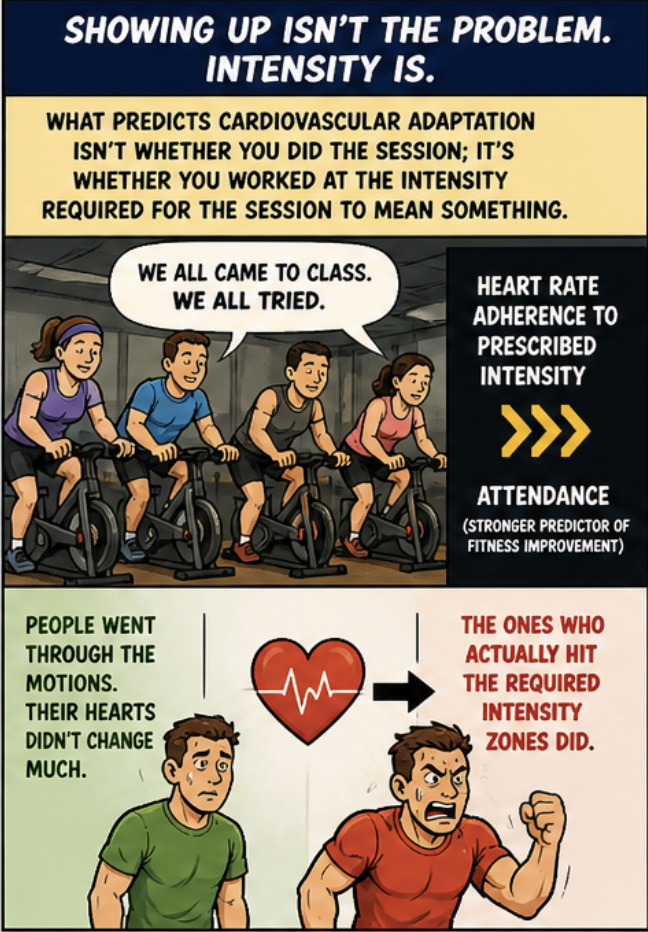
That finding has a sharper edge than it first appears. It means showing up isn't the problem. Attendance is not the limiting factor. What predicts cardiovascular adaptation isn't whether you did the session; it's whether you worked at the intensity required for the session to mean something. One study on aerobic training found that heart rate adherence to prescribed intensity predicted fitness improvement far more strongly than attendance. People came to class. They went through the motions. Their hearts didn't change much. The ones who actually hit the required intensity zones did.
The mechanism here is straightforward, even if it's rarely explained. Your cardiovascular system adapts to the demands placed on it. If you're working at an effort level your body can sustain indefinitely, a moderate jog, a comfortable bike ride, a spin class where you're working but you could also carry on a conversation, the demand signal is weak. The heart doesn't need to grow stronger to meet that demand. It's already strong enough. The adaptations you're hoping to earn require you to work at intensities where your cardiovascular system is genuinely near its ceiling, somewhere in the range where sustaining effort for more than a few minutes becomes a serious challenge. That's uncomfortable in a way that a long, steady, sweat-producing workout is not, even if the long workout feels harder when you're done.
This is the crux of the confusion. Tiredness is not the same as intensity. A ninety-minute run at a pace you can maintain indefinitely will leave you exhausted. It will not push your cardiovascular system into the territory where it has no choice but to adapt. A twenty-minute session where you're working at or near your limit with repeated hard efforts will feel brutal, be over quickly, and do more for your actual fitness than most people's full weekly cardio output. The research on this is not ambiguous. Interval-based training and sustained high-intensity efforts consistently outperform moderate-intensity steady-state work for the adaptations that matter.
None of this means that low-intensity cardio has no place in a training program. It does. Zone 2 work, long aerobic sessions, and active recovery serve real purposes for recovery, metabolic health, and aerobic base-building in the context of a structured program. The problem is that for most recreational exercisers, this is all that's happening. The entire cardio portfolio is moderate-intensity, moderate-duration, and moderate-effort, resulting in moderate-to-minimal fitness gains while providing a strong sense of having put in the work.
That feeling is the problem. It's not that you're not trying. It's that the effort you perceive and the signal your body needs are operating on different frequencies, and no amount of time on the treadmill closes that gap if the intensity stays the same.
The fix isn't complicated. It is, however, harder than what most people are currently doing, not longer, and not more often. Just harder, and specifically harder in the ways that cardiovascular physiology actually responds to. If your cardio sessions never include efforts where you can't speak in full sentences, where sustaining the pace for more than a few minutes is genuinely difficult, and where the session ends not just because the clock ran out but because you have very little left, then you've been doing something. You just haven't been building fitness.
That's a different problem than most people think they have.
There is a lot to unpack here. Understanding these systems is one of the main reasons that people with coaches or those who attend smartly programmed gym programs greatly outperform those who choose to do it themselves. And by performance, I don’t just mean sports. In all areas of their lives.
See you in the gym. —JG